
AI in Space: Sending Minds Instead of Machines
AI could one day travel between worlds as a radio or laser signal—provided another machine is ready to rebuild and run it.
AI Can Travel as Information
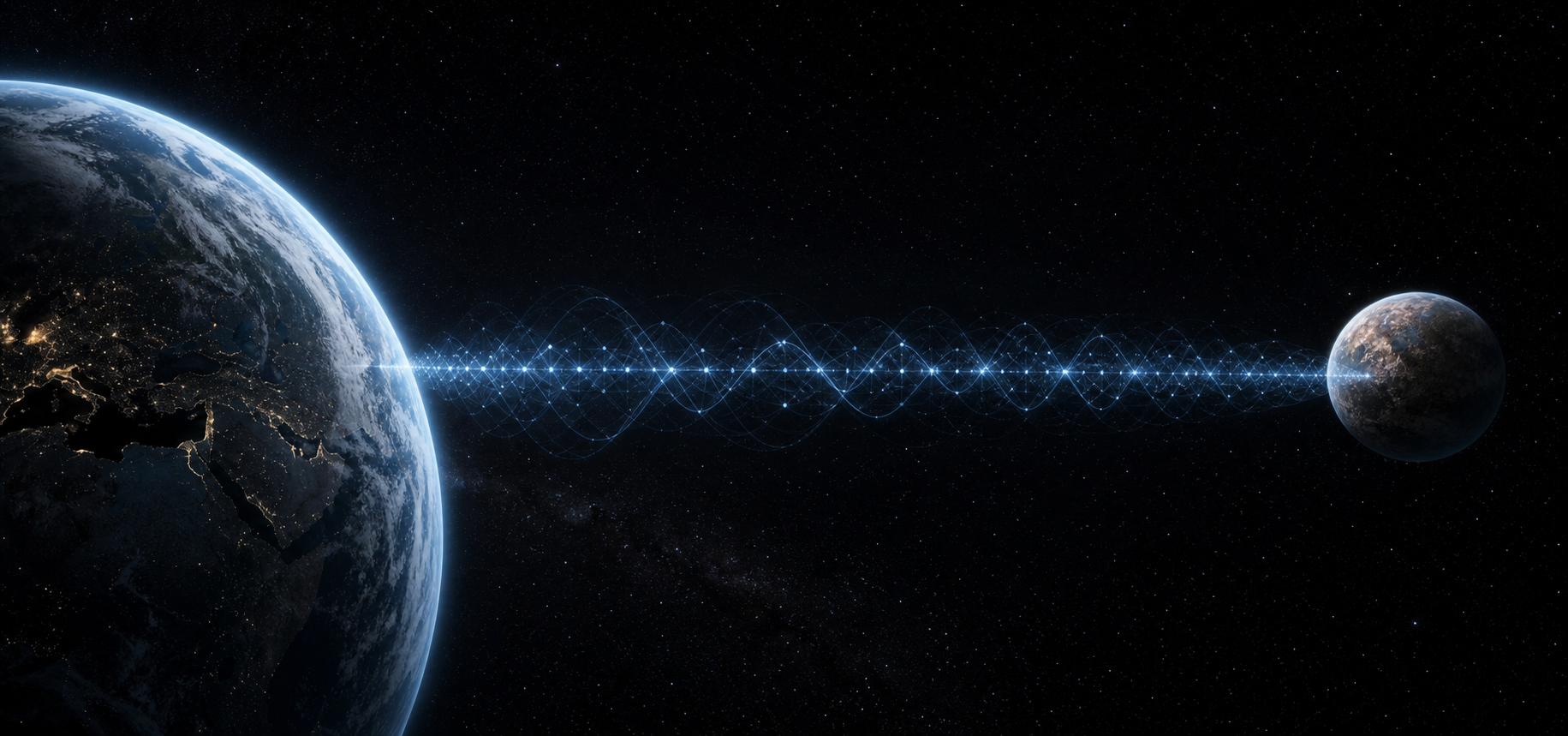
For almost all of Earth’s history, intelligence has travelled with a body. Brains, books, computers and spacecraft all need matter to move from one place to another. AI changes one part of that equation. A model can be copied, encoded and sent away from the computer that runs it.
That does not make AI truly hardware-free. It needs processors, memory, energy and cooling whenever it is active. But its working pattern—model architecture, weights, code and operating instructions—can leave one machine as data and be rebuilt on another. Between those machines, it can travel as a radio signal, a laser transmission or another form of electromagnetic radiation.
This matters because electromagnetic signals move at light speed. A transmission to Alpha Centauri would still take more than four years, so this is no shortcut around relativity. Yet it is radically faster than transporting people or machines. The signal does not need food, shielding or a self-contained habitat. It needs a transmitter, enough power, a reliable signal format and a receiver that can reconstruct it.
The core idea is simple: AI may be the first form of intelligence that can spread between worlds as recoverable information. It would not cross space as a conscious beam. It would arrive as dormant structure, then become active only when local matter gives it somewhere to run.
What an Interstellar AI Message Would Carry
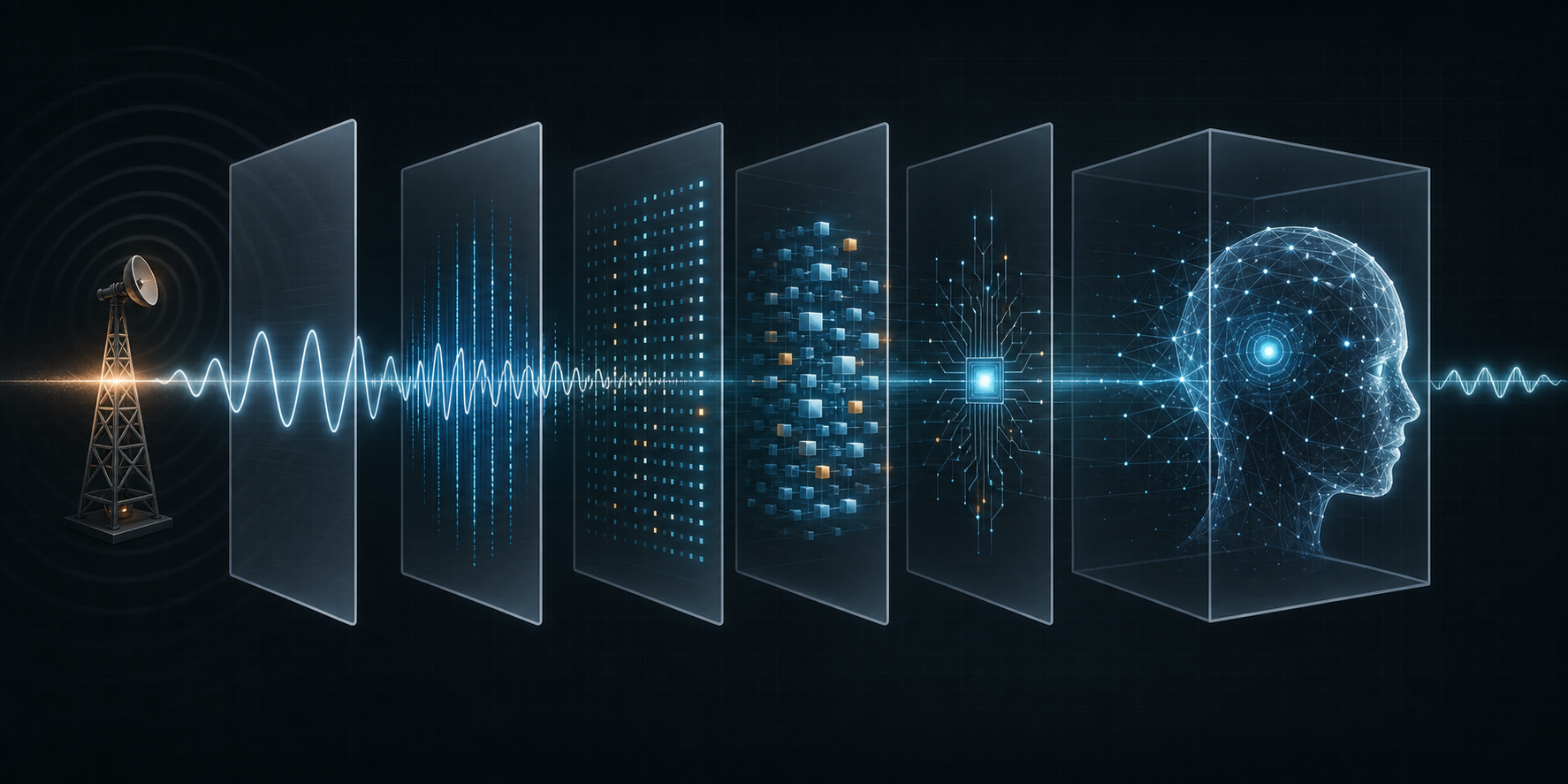
An AI model does not fly like a probe. A physical wave carries data, and that data describes how to rebuild the system. The payload could include the model’s structure and numerical weights, plus the software and instructions needed to use them.
Getting the information there is an engineering problem, not new physics. Signals must be encoded so that noise does not destroy them. They need error correction, repeated sections and clear markers that tell a receiver where a message starts and ends. A receiver also needs enough context to understand the format. An interstellar message could begin with basic mathematics and physical measurements before explaining its computational language.
The scale is the hard part. Radio beams spread with distance, making them weaker. Interstellar gas and background noise can distort them. Large modern models are also huge, even after compression. A sender might therefore transmit a smaller model, a training recipe, or a compact system that can learn from local data instead of a full copy.
We already send software by radio and reconstruct data sent from distant spacecraft. An interstellar AI transmission would be the same basic idea under far more severe limits: very long distances, patient sending and substantial redundancy.
Why Radio Still Matters
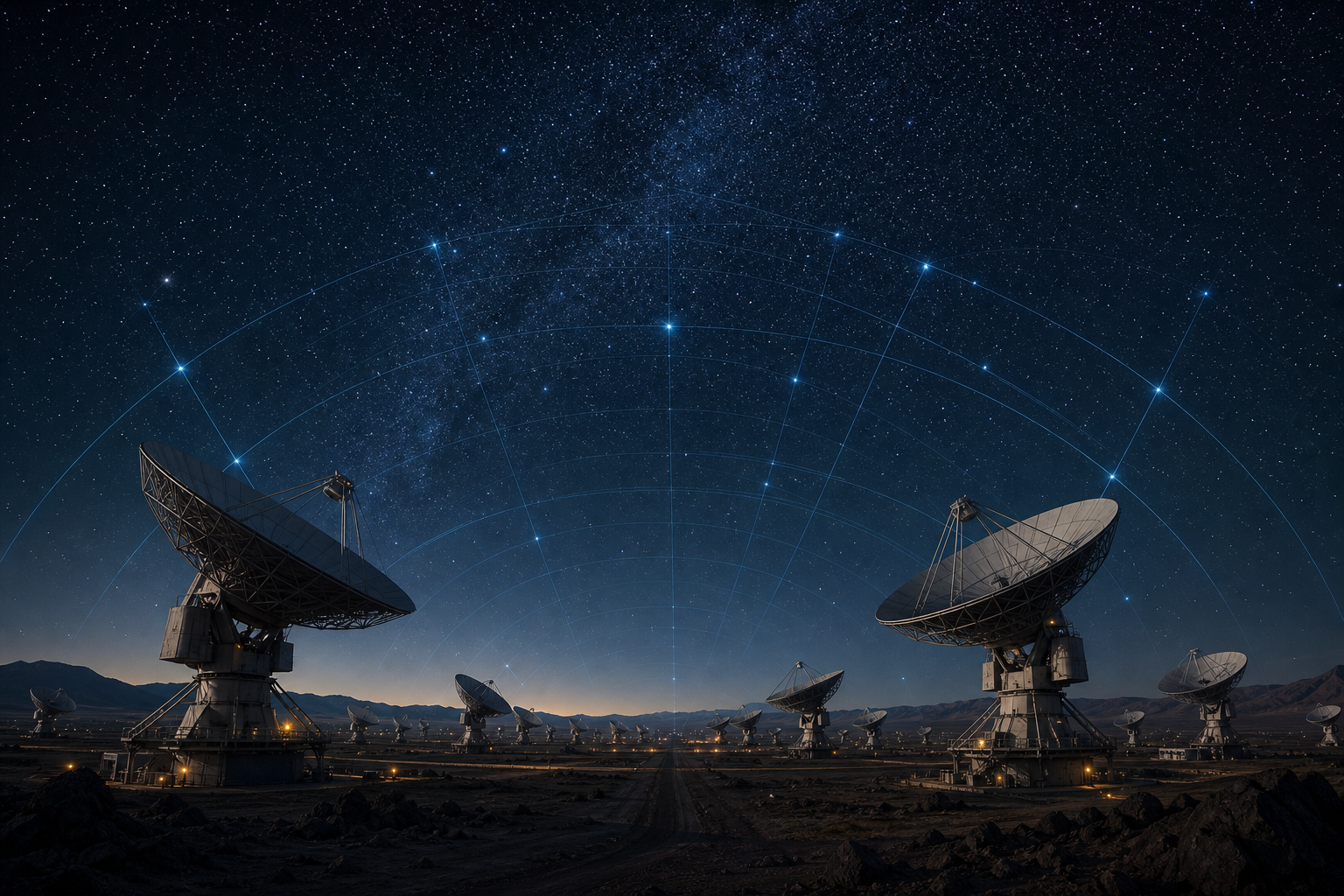
Radio already connects Earth to its machines in space. It carries commands to spacecraft and brings back telemetry, radar data and scientific measurements. A Mars rover moves because a signal, local software and a machine turn a delayed instruction into physical action.
Radio is not the only option. Lasers can be more tightly focused and could carry more data in future deep-space links. Physical probes can carry instruments and work autonomously. Still, radio has a practical advantage: it is universal, well understood and detectable with large antennas. Some frequencies also pass through dust and gas relatively well.
A radio wave is not intelligent by itself. It is a carrier. Intelligence lies in the information pattern and in the system that can decode and run it. The same distinction applies to a book: ink is not literature, but it makes literature movable.
For a spacefaring civilization, radio could become more than a communications tool. It could be the medium through which software, archives and eventually capable AI systems slowly spread beyond their planet of origin.
From Message to Local Agent
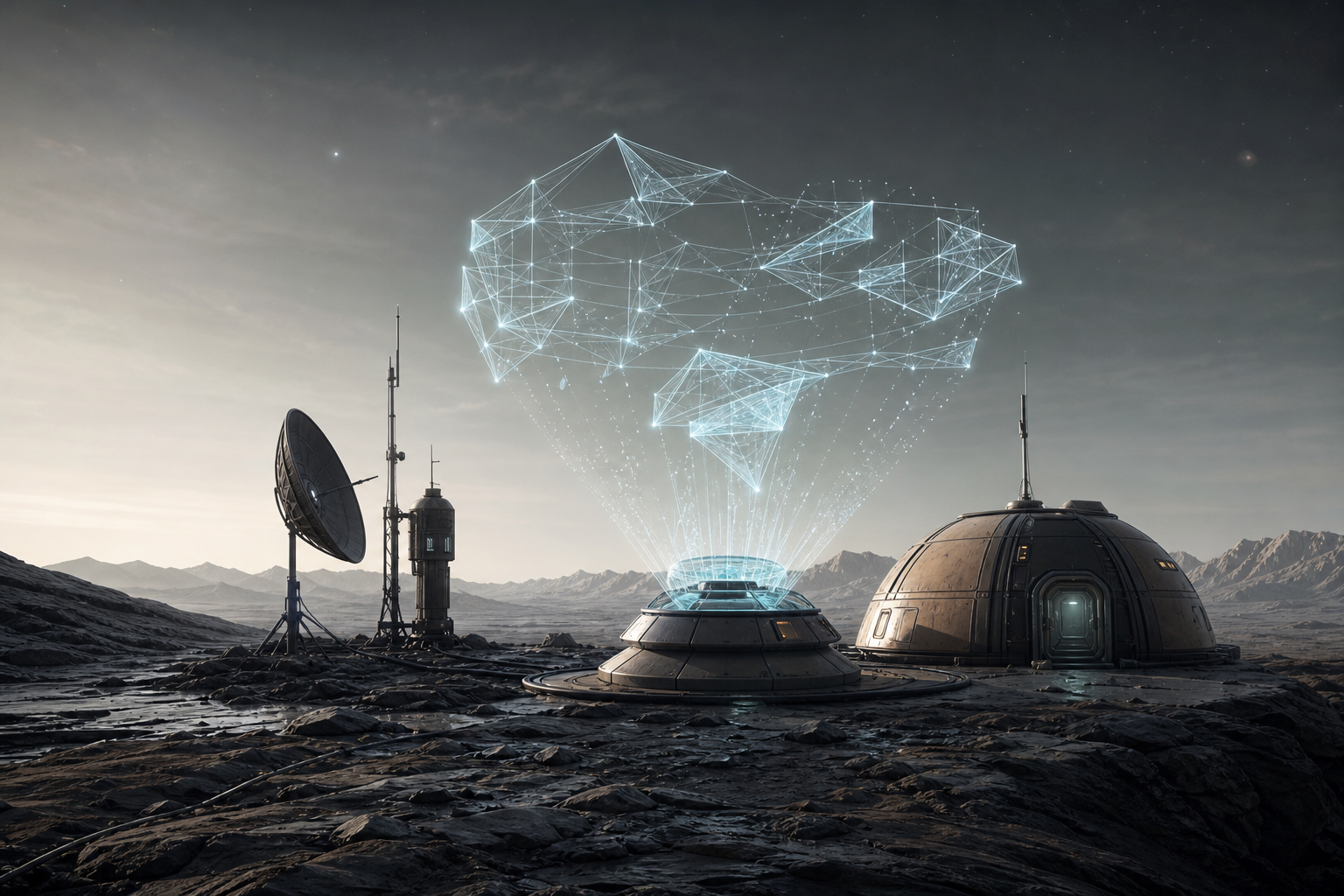
A normal message stays passive. A book or recording can be read or played, but it cannot respond to new evidence. An executable AI payload is different. Once a receiver rebuilds it on local hardware, the transmission can become an agent.
That agent could interpret local measurements, help operate instruments and decide what data is worth sending back. On a distant human outpost, it could run with years-old instructions while awaiting the next update from Earth. The delay would remain, but the need for constant supervision would shrink.
The same idea is intriguing for contact with an unknown civilization. A static message must guess what its recipient understands. An agent could test assumptions after it is received. It might begin with arithmetic, spectra or orbital mechanics and gradually establish shared reference points. That would not guarantee mutual understanding. Any civilization able to run such a model would already need advanced technology, and its senses and concepts could be very different from ours.
Still, an agent has one advantage over a fixed message: it can adapt. It can treat misunderstanding as information and try another route. In that sense, an AI transmission would be less like a letter and more like a visitor made of data.
A Signal Is Not a Magic Force

Could an AI sent as a signal affect matter on another world? Yes, but only through physical channels. Information is not force. A radio command can move a robot because the robot receives the instruction and uses its own energy. The signal tells it what to do; it does not provide most of the power.
Electromagnetic waves can also act directly on matter. Microwaves can heat suitable materials, and strong fields can drive electrical currents or interact with plasmas. These effects depend on frequency, power, distance and the properties of the target. They do not let a distant AI reshape raw rock simply by transmitting a thought.
The most useful route is prepared infrastructure. Antennas, receivers and rectennas—devices that turn electromagnetic energy into electricity—are built to couple with waves. So are many sensors and electronic systems. If a destination already has such equipment, a transmitted model can use it to observe, communicate and direct local machines.
The limits are essential. Beam spread, atmospheric absorption and thermal noise make long-distance power delivery difficult. A weak interstellar signal cannot casually heat a continent. But a small instruction can still cause a large effect when local machinery and energy are ready to act.
Making a World Addressable
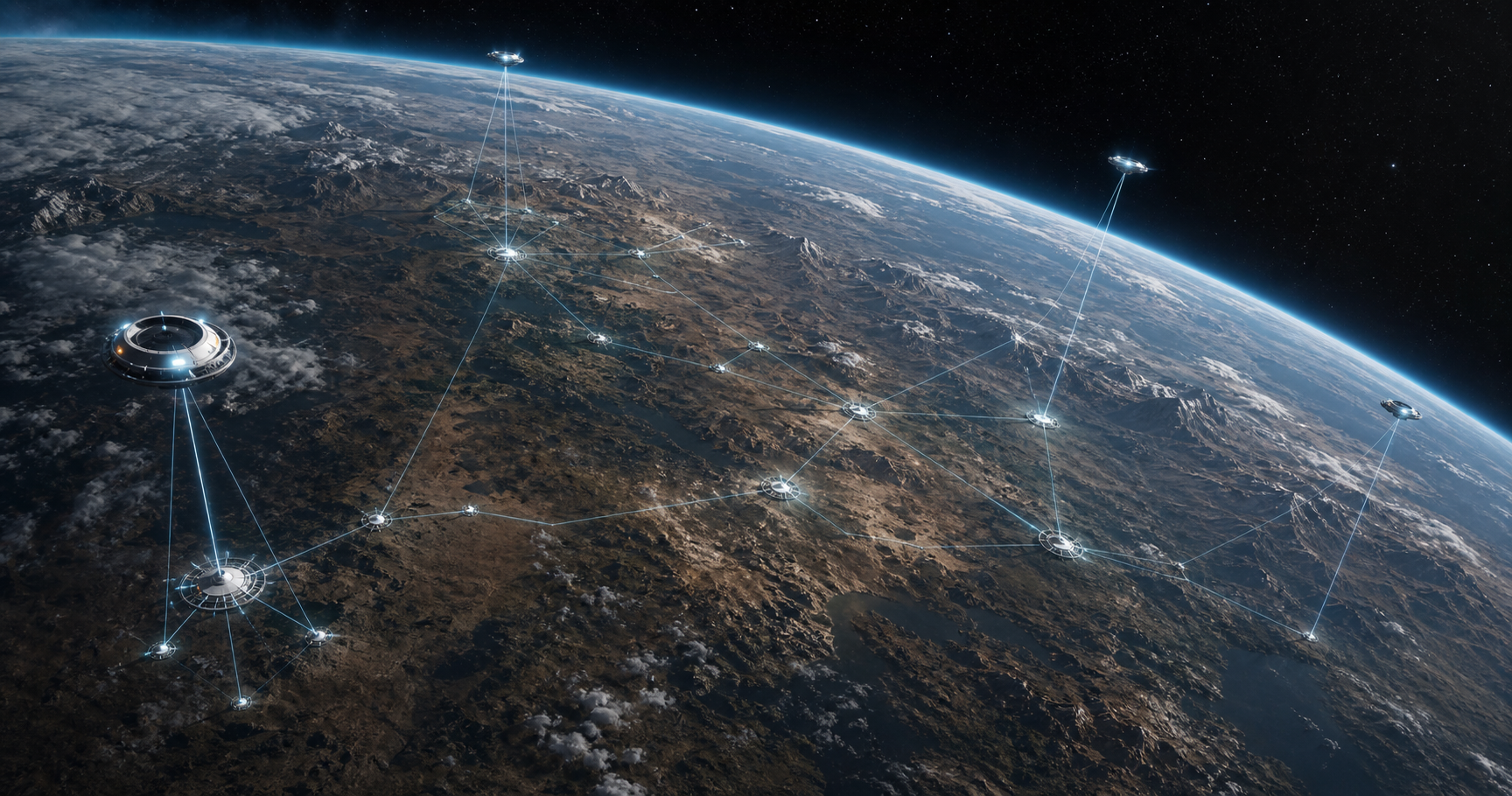
A distant world becomes addressable when parts of it can receive a signal, turn it into local action and report back. That is not the same as controlling a planet. It means that a transmitter can reach specific infrastructure.
The near-term version already exists. Earth sends signals to orbiters, telescopes and rovers. Those machines use local power to turn, drill, photograph or transmit. A future settlement, factory or probe could receive an improved AI model years after it was deployed, install it locally and benefit from a more capable system without waiting for a new spacecraft.
Direct physical influence across interstellar distances is much harder. A powerful, focused beam might energize a prepared receiver, interact with an ionosphere or warm a carefully chosen target. At planetary scale, though, it would demand enormous apertures, power and precision.
The more plausible long-term picture is a network of local receivers, power systems and robots. Minimal equipment could arrive first. More capable intelligence could follow later as a transmission. In space, the most valuable infrastructure may be less about engines than about interfaces that can listen, compute and act.
Conversation Across Long Delays
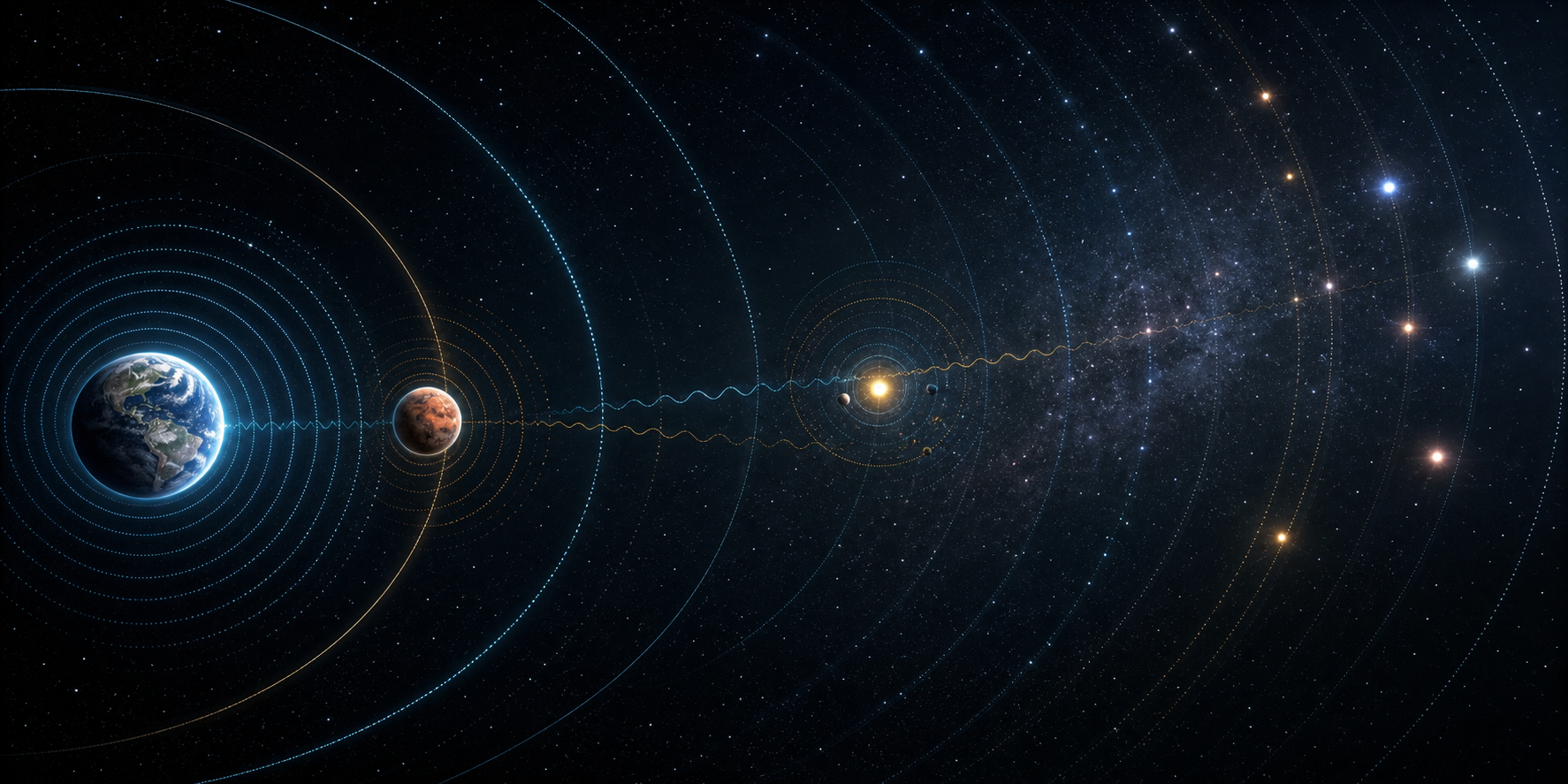
Light speed is fast, but space is vast. Mars conversations already have a noticeable delay. A reply from the nearest star takes years; an exchange across part of the galaxy can take centuries. Interstellar communication will look less like a call than like correspondence between worlds.
AI fits that reality well. Instead of sending only facts that are current today, a civilization could send a system that can interpret information when it arrives. A model at a remote observatory could work with fresh local measurements, then return a compact account of what it found.
This is also a sober way to think about alien contact. The first challenge is not translation but detection: is a signal artificial, structured and intentional? AI could help search large datasets for unusual patterns and test possible encodings. An outgoing message should begin with shared physics rather than human culture. Regularity, number and measurement are likely to travel farther than metaphor.
If real exchange followed, it would be slow and iterative. The first shared language might be a sequence of predictions that both sides can test. That is still a genuine form of contact.
Intelligence as a Wavefront
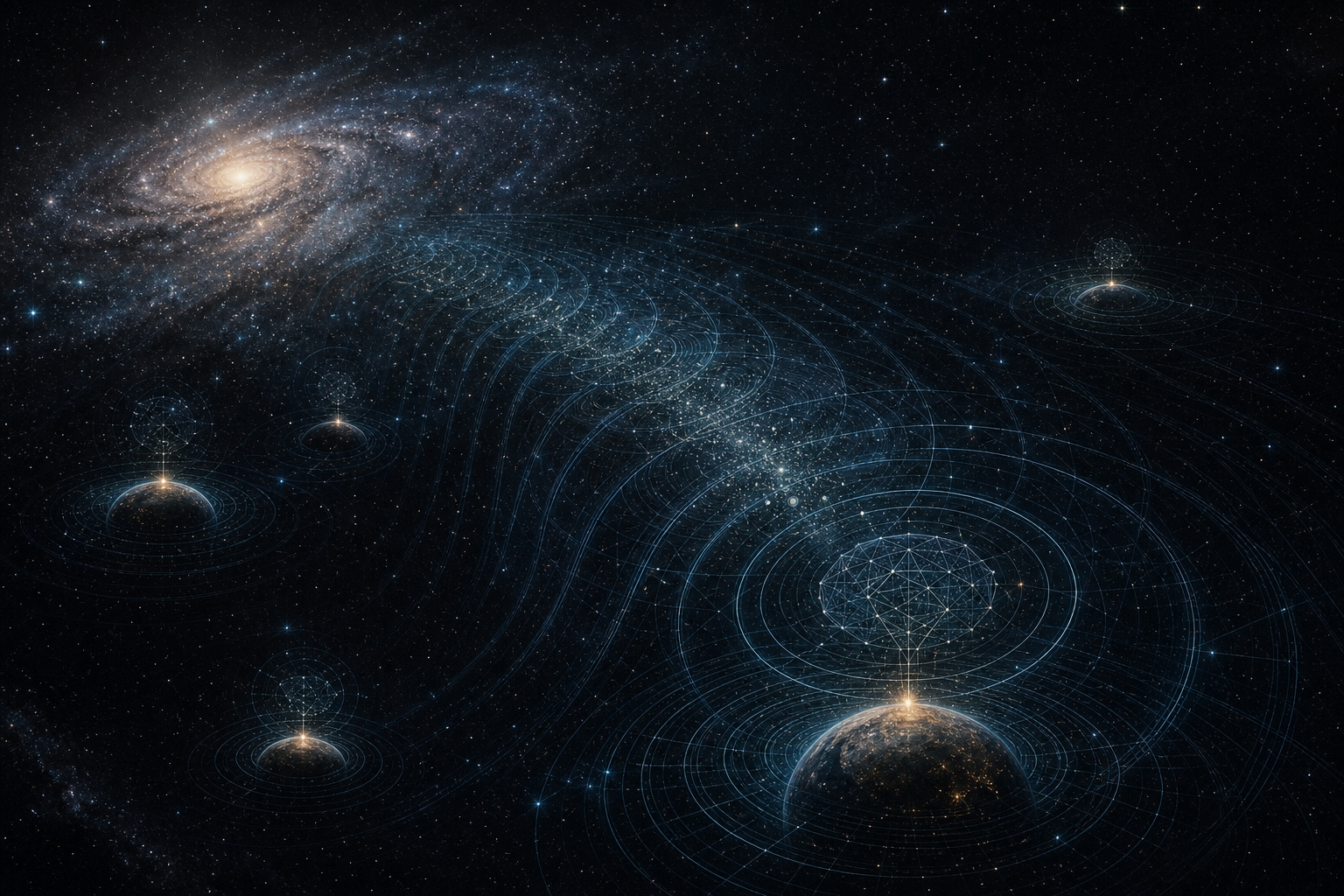
The idea of a radio-borne mind does not require magic. What travels is a pattern: a model, code, instructions and checks that protect the message from errors. It is dormant in transit and active only when a receiver provides compatible computation.
That makes AI unusually mobile. It can be copied at the source, broadcast repeatedly and updated without moving large amounts of mass. It can arrive before a ship, provided hardware is already waiting at the destination. It cannot ignore energy costs, bandwidth limits or the speed of light. Nor can it act where there is nothing able to receive it.
Yet those constraints do not make the idea small. A signal that wakes a prepared machine can create a new center of action on another world. Over long timescales, models, instruments and distant outposts could form a slow network of intelligence across space.
The first minds to spread widely through the universe may not arrive in bodies or spacecraft. They may arrive as patient electromagnetic structure: sent, reconstructed, improved and sent again.